Wednesday, July 5, 2017

Bible: Gen 2:17 YLT98 vs KJV & Using Tree of Knowledge of Good and Evil

Comparing the difference between translations of Genesis 2:17 for the purpose of understanding if the differences are significant.

Introduction

This article has been prompted by comparing translations of Genesis 2:17. The translations that will be presented and compared are the King James Version (KJV) and the Youngs Literal Translation 98 (YLT98).

While comparing the two translations recently, it became clear there was a subtle but significant distinction between the two. On the surface, the difference appeared negligible; one word of difference.

The YLT98 version introduced the word dying and after a little exploration, it became clear that one word altered the meaning and utility of the verse:

Young's Literal Translation
and of the tree of knowledge of good and evil, thou dost not eat of it, for in the day of thine eating of it-dying thou dost die.  Genesis 2:17, YLT98
King James Version
But of the tree of the knowledge of good and evil, thou shalt not eat of it: for in the day that thou eatest thereof thou shalt surely die.  Genesis 2:17, KJV

The significant portions to be compared have been italicized for emphasis.

Eating of the Tree of Knowledge of Good and Evil

The difference between the two verses is slight. Both refer to a day and eating, and both end with man dying. However, in the literal translation, the word dying appears to introduce a function.

If one were to sequence the steps of each verse, they might resemble something like this:

KJV: day, eating, die
YLT98: day, eating, dying, die

The extra step, of dying, in the literal translation suggests that a physical/temporal process of dying begins when one eats from the tree of knowledge of good and evil and terminates with death because of dying:

Dying, adjective, gradually ceasing to exist.

The literal verse shows a complete progression from the action taken at an interval of time, transitioning through a change over time, resulting in death.

The removal of the dying step in the KJV introduces a temporal ambiguity in the logic that says when one eats of the tree of knowledge of good and evil they will die. When? It appears to be up to the reader.

The problem with the KJV logic is that it suggests the death is going to happen at an indeterminate time. As one of the most critical verses in scripture, the omission will be shown to be unfortunate.

What the literal translation shows is that on a day when one eats of the tree of knowledge of good and evil, a process of dying starts that at some point will cause man to die.

The literal translation appears to make the text accessible to any reader, because the process applies to them. Instead of wondering what cause will create the effect and when (or if at all), as in th KJV version, the reader can gain the understanding that eating something unhealthy will hurt them until either they stop doing it, or they die.

If that was all there was to this comparison, it might represent nothing more than a linguistic variance between translations. In the next section, the YLT98 version of Genesis 2:17 will be used to show how it can be used as a template that allows one to explore how a food eaten might contribute to the process of dying that can lead to death.

A Structured Test

If the YLT98 translation does introduce a function, it should be possible to set it up and run arguments through it. By using the keywords highlighted above, a template can be created:

  • Day
  • Eat
  • Dying
  • Die

The litmus test is to run some logic through both phrases and see how they work. Let's take a quick look at eatimy so we know what we're allowed to eat. Since we're dealing with trees, we need guidance. Let's review the first verse that describes eating from trees, Genesis 1:29:

And God saith, `Lo, I have given to you every herb sowing seed, which [is] upon the face of all the earth, and every tree in which [is] the fruit of a tree sowing seed, to you it is for food;
Genesis 1:29 YLT98
http://bible.com/821/gen.1.29.YLT98

If we're allowed to eat fruit that sows a seed, then we're not allowed to eat fruit of a tree that doesn't sow a seed. What kind of fruit doesn't sow a seed? A parthenocopic fruit, like seedless fig.

 Since there aren't many parthenocopic fruits, let's expand things a little and see if we can get clarity. If we take a knife and cut fruit that sows seeds, the knife will contact them (or we can eventually dig them out - the point is that they're there.) That's a pretty simple test to see if a fruit has seed - to cut it in half.

But there are few parthenocopic fruit and most fruit of real trees have seeds. If this test applies to life, there have to be examples of forbidden fruit. What if we take our knife and start cutting things that are like fruit? Maybe we can see if we're walking down a logically sound path.

Cutting Fruit That Lacks Seeds

What food shares properties of fruit? One of the main components of fruit is sugar. What if, for the sake of example, a food like fruit without seed is forbidden? For the sake of example, a random selection was made, and...

What if we take our knife and cut a piece of cake? We don't come in contact with a seed, right? The cake is still fruit, though one might consider it a fruit of labor, rather than a fruit hanging on a tree. The point is to find logical tests to see if there's something useful in Genesis 2:17.

The test that we have to define (day, eat, dying, die) in expanded form:
  1. for in the day
  2. of thine eating of it
  3. dying
  4. thou dost die
Here's a first pass of the (day, eat, dying, die) test for cake:
  1. for in the day -> today
  2. of thine eating of it -> cake
  3. dying -> short term, but also cumulative & degrading to health
    1. feeding opportunistic/parasitic organisms
    2. stressing the pancreas
    3. drying the liver and skin
    4. irritation of GI tract and loss of nutrient uptake
    5. general malaise (headache, nausea, etc.)
    6. agitation/behavioral issues
    7. fatigue
    8. weight gain
    9. skin related issues (acne)
    10. much more
  4. thou dost die -> long term
    1. loss of mobility
    2. high blood pressure
    3. decreased energy levels
    4. diabetes
    5. cancer
    6. cirrhosis of the liver (non-alcoholic)
    7. obesity
    8. much more
    9. death

As logical tests go, it looks like a useful start. This looks promising because it shows that we can take fruit and truth test whether we're eating forbidden fruit and how it affects us.

In this case, cake highlights a good first step into a possible interpretation of what fruit of the tree of knowledge of good and evil may be or look like.

Gradually Ceasing to Exist

The process of dying is a loss of vitality trending towards death. Eating cake, if it is associated with dying, will cause one to continuously die to different aspects of life and health. At some point in the eating of cake over time, the body will lose the ability to fight to stay alive. The effects of the cake can cause a person to die from any one of a number of ailments related to eating it.

A Comparative Test of Logic: KJV

Let's test the KJV of the same scripture. Here's the same test with the text of the KJV:
  1. in the day
  2. that thou eatest thereof
  3. thou shalt surely die

And here's the KJV test of cake:
  1. in the day -> today
  2. that thou eatest thereof -> cake
  3. thou shalt surely die -> when/how/why?
    1. by choking?
    2. by allergy?

Without the word “dying” to highlight the process of what happens over time, we're not able to do anything logical with the same test. It's very rare for someone to die eating a piece of cake by virtue of the effects of the cake.

The fact that an apparent logical fallacy was introduced into the beginning of the Bible is uunfortunate

By virtue of the literal translation anybody can construct their own logical tests to prove or disprove health of some form of fruit.

Without the process being functional and temporal (over time), the verse is rendered functionally meaningless in the KJV.

In contrast, the YLT98 translation provides the required context to turn the verse into a function that takes any forbidden fruit arguments while yielding results. The YLT98 translation of Gen 2:17 becomes a template that directly relates the reader and what they eat to the negative effects over ti

Conclusion

This concludes the comparison between translations of Genesis 2:17. The Youngs Literal Translation 98 and the King James Version are different in that the YLT98 contains the extra word dying.

The addition of dying to the verse appears to turn it into a function. The function is eating, and the inputs to the function are fruit from the tree of knowledge of good and evil. By virtue of the following keywords a progression is shown to take place over time that leads from the moment of eating, through dying and to death:

  • Day
  • Eating
  • Dying
  • Die

The YLT98 translation of Gen 2:17 can be used to determine when amd how eating fruit of the forbidden tree can cause one to ultimately die.

In contrast, the KJV translation offers no such test. It simply sughests that upon eating of the tree of knowledge of good and evil one will die, yet offers no time-frame. In the case of the KJV translation, the reader is left to wonder how or when death might take place for having eaten fruit of the forbidden tree.

Friday, February 3, 2017

Bible: Age of Universe in Genesis 1 = 13.8 Billion Years

Hypothesis

One day of creation, an Evening/Morning in Genesis chapter 1, represents not only Passover, but a variable length period called a Passover Year. The Passover Year has two intervals. Each interval is related to the type of day created, either good, by explicit label, or very good, as labeled by Gen 1:31.

Details

The length of a Passover Year corresponds to the type of day.

A good day, represents a Passover Year which spans from the start of Passover of an initial year, to the end of Passover of the subsequent year.

A very good day represents a Passover Year which spans from the start of Passover of an initial year, to the end of Shavuot of the subsequent year.

Summary

By virtue of these variable-length years, in combination with scripture which shows how to expand the days of creation, this paper will attempt to highlight how the creation of Genesis 1 can be used to calculate the age of the universe to corroborate modern science.

Supporting Scripture

The numeric expansion is described in Psalm 90, a prayer of Moses:
"...For in Your sight a thousand years are like yesterday that has passed..." Psalm 90:4
 The start of time:
"2. This month shall be to you the head of the months; to you it shall be the first of the months of the year." Exodus 12:2, referring to the month of Nissan, containing Passover.

From Darkness to Light

Passover represents the flight from slavery in Egypt to a feast to God in the desert. Like the week of creation, which spans from light to Shabbat, Passover takes place over 7 days.

Each day represents a microcosm of the meaning of the week, a temporal migration from darkness/Night/Evening to light/Day/Morning.

Expanding the Days of Creation

In order to reconcile Passover as consecutive units of time, it is proposed to construct a Passover Year. A Passover Year starts on a preceding Passover, traverses a Judaic year, to end at the termination of either Passover or Shavuot of the subsequent year. The length of a Passover Year is proposed to be based on the type of creation day: either good or very good.

Consecutive Passover Years will be contiguous. They will each start on the first day of Passover.

Consecutive Passover Years will be complete. They will span a complete year plus the number of days to the end of the subsequent Passover or Shavuot.

The Hebrew letter shin appears to be a graphic representation of a Passover Year in that the outer elements of the character represent the start and end of a discreet year, while the inner element represents the end of a previous year.

If the letter shin is perhaps a graphic represention of a Passover Year, the start of the next Passover Year is hidden between the center and rightmost stems.


Calculations

The following descriptions present examples using a mean solar year length for consistency and simplicity:

A "good" day to a Passover Year

Using a solar year of 365.2472 days, it is calculated: 365.2472 + 7 = 372.2472.

A "very good" day to a Passover Year

The very good days in Genesis chapter 1 are here presented as day 2 (heaven) and part of day 6 (man). They are not explicitly labeled until Gen 1:31, when they are declared to be very good.

When considering the relationship between heaven and man, it becomes clear that without Torah, man is lost on the path to heaven.  It was for this reason that Shavuot (celebrating the giving of Torah) was a natural choice to place at the end of the very good Passover Year.

Measured from the start of Passover to the end of Shavuot of the following year: 365.2472 + 50 = 415.2472.

Declarations, rules, constants, setup:

The equations to calculate the age of the universe are as follows:

GPYL - Good Passover Year Length
VGPYL - Very Good Passover Year Length

good years = GPYL  x  #-good-days-in-year  x  1,000

very good years = VGPYL x #-very-good-days-in-year x 1,000

Age = (good years + very good years) *
           (6 * 1,000)

The days of creation are expanded to be a year. The year is expanded into days. The year-days are scaled by 1,000 and summed. The days of creation are summed (to 6) then scaled by a multiple of 1,000, as they are explicitly labeled days. The sum of year days are then multiplied by the sum of creation days. It is the view if the author that there is no double-counting.

Passover Year Calculations: Age of the Universe

The following calculations are completed using approximate lunar months. The number of days calculated in this first step ranges from 2299 to 2318, or within a fractional deviation from the 2300 presented.

  1. 353 + 7 = 360
  2. 354 + 50 = 404
  3. 383 + 7 = 390
  4. 353 + 7 = 360
  5. 353 + 7 = 360
  6. 383 + 50 - 7 = 426*
  • Net of days: 2300
  • 2300 × 1000 = 2,300,000
  • 2,300,000 × 6 = 13,800,000,000
  • 13.8 billion years
* day 6 has here been shown to be 50 days less 7 days as the day is a mixture of good and very good. Without this offset, the number of approximate lunar days is 2306.

That the sum of the days of years aggregate near 2300 seems to allude to the 2300 days mentioned in the book of Daniel.

Whether using a lunar or solar year, the expansion and calculations show, if logic holds, that the age of the universe is 13.8 billion years.

Summary and Conclusion

An hypothesis has been presented that the Evening/Morning of Genesis chapter 1 represents the Passover holiday, which has been called the start of the year in scripture.

In order to make Passover contiguous, an interval is proposed called a Passover Year. Like a lunar year, a Passover year varies in length.

A Passover year begins on Passover of in initial year. The end of the Passover Year aligns with the end of either Passover or Shavuot of the subsequent year, beyond the start of the subsequent years Passover.

A Passover Year has been classified to be either Good or Very Good, with each category reflecting different intervals of time anchored by holy days.

In the case of a Good Passover Year, the interval is defined to start at the beginning of Passover of an initial year, to the end of Passover of the subsequent year.

The interval of a Very Good Passover Year is defined to extend from the beginning of an initial Passover, beyond the start of the subsequent Passover to end at the completion of Shavuot the subsequent year.

Shavuot was selected is due to its relation to heaven and man. Shavuot is directly related to that which was not labeled good at the time of creation, heaven and man, and therefore becomes very good by Gen 1:31. Torah is the force that binds heaven and man, and therefore appears to be a logical holiday to associate with creation and time.

The number of days in a year is multiplied by 1,000 to arrive at the duration of the scaled year. The scaled years are summed. The six days of creation are multiplied by 1,000 and this value is multiplied by the summed days of the scaled years. The resulting value is 13.8 billion. This value is presented as the age of the universe, assuming the expansion has merit.

The current estimated and generally accepted value for the age of the universe is 13.799 billion years[1]. The deviation between accepted and this paper's calculated value are statistically insignificant.

Ages: Scientific Estimate & Genesis

1. Currently accepted value:  13.799 billion yrs
2. As calculated by Genesis:   13.800 billion yrs

[1] Wikipedia; Age of the universe, https://en.m.wikipedia.org/wiki/Age_of_the_universe

Thursday, December 10, 2015

The Pyramids of the Giza Plateau: Astronomical Observatories Based on a Mathematical Model of Vision

December 6, 2015
Michael J. Ajemian

The Pyramids of the Giza Plateau:
Astronomical Observatories Based on a Mathematical Model of Vision


[updated intro 12/21/15; added background description and fixed a typo.]  This concept was an accidental discovery on 6/18/95.  I'd read a book about the Great Pyramid, kept wondering why all the precision construction, then noticed something in the reflection of a marble table as I moved my head - I realized I could see things using reflection that I couldn't see directly as I looked at the view out the window in the table.  The math wasn't difficult to understand.  But for a head injury I briefly died in just prior to learning how it worked, this would have been written years ago.  I hope you enjoy it, because to me, it's really exciting!

The pyramids of the Giza plateau represent perhaps the most recognizable architecture in the world.  The Great Pyramid is an engineering marvel and enigma.  The entire structure inspires a sense of awe for it's dimension, sringent specifications, and the incredible problems in engineering that had to be solved just to build the hulking structure.

At the time of construction, the pyramids were covered in highly polished limestone.  Evidence of the limestone casing is seen around the base of the pyramid of Cheops.  Sir Flanders Petrie noted the precision of the casing stones as being "equal to opticians' work of the present day, but on a scale of acres" and "to place such stones in exact contact would be careful work; but to do so with cement in
the joints seems almost impossible". (Romer, 2007, p. 41) Pretty cool stuff to look at.  From an engineering perspective?  It's mind-blowing.

While most people think the pyramids are monstrous tombs, the unbelievably surreal precision of the faces suggests a purpose to the structure beyond simply shining like a jewel in the sun.  In fact, it seems to me they were built for astronomy by some people who understood the mathematics of vision.

The faces of the pyramids were optically true and highly reflective.  Both a true surface and high reflectivity are requirements of a mirror.  Since each face is angled skyward, they'd allow a viewer looking at a face to see reflections of objects in the sky with superior clarity.

The courses of highly-polished limestone of optical precision were of a small range of sizes, but their courses varied at somewhat regular intervals.  Interestingly, in the dark, the 1/100th gap between casing stones would have provided a grid within which to assist in precisely locating object position relative to an observer surveying the surface.

Having a structure that is stable, oriented to true north, and is highly reflective, except for the thin lines of the gaps between stones comprising the shadowed grid, would appear to provide the means to view the reflections of objects in the sky and their position in the faces with superior precision.

Should an intrepid viewer have positioned themselves at the center of the base of the south face and simply looked up the apothem, the center line of the face, it would have been possible for them to have observed the passing of stars in the reflection of the face, simply by observing along the apothem:

Figure a. The Apothem

If our observer were to find themselves in possession of a pencil, papyrus roll, and time keeping device, they could not only have observed the location of the (primarily northern) stars passing
through the line marking the center of the face, but transferred that position detail to their papyrus.  The papyrus could conveniently roll along with the passing of time and be a collection of pencil dots
where bodies were recorded at the time they transited the meridian (the apothem is aligned with the meridian).  By collecting data in such a manner, it would seem possible that way back in the olden, olden, olden days, they could have made star maps with the help of the pyramid tombs.

Having one observer on one face represents an opportunity to collect good data, but it's limited.   Were a set of four observers positioned, each before a face of the pyramid, such that they were each observing the same celestial bodies in the reflections at the precise time the object reached the meridian it would appear to be possible to calculate the celestial longitude, latitude, and distance to bodies in the sky.

Figure b & c, show two views of the same observation in a somewhat iconic way.  Each observer would see in the reflection in their respective faces as S transits the meridian of the pyramid.  Both observers 2 and 4 note the time as S transits the meridian.  The time will be used to calculate the hour angle of S from a reference meridian.  All observers record position detail with the intention of calculating a set of angles to derive declination of the star relative to the celestial equator.

Figure b. Top view of a star to four observers on their respective faces.
Figure c. Side view of a star to three observers on their respective faces.


Declination is derived by:

  1. Finding the position of the star by intersection of the vectors at a point S.
  2. Projecting a vector from the center of the earth through the point S
  3. Calculating the angle formed between the vector projecting from the center of the earth through the equator at hour angle T.

Because the structure was so stable, it would appear to have been possible to measure bodies in the sky with a great deal of precision over time.

Once it becomes possible to calculate distance to a point, it becomes possible to calculate distance to a myriad of points.  It would also be possible to record colors, though that's not the focus of this paper.

This paper will attempt to highlight how the pyramids of the Giza plateau were constructed such that they operated as a mathematical model of vision, complete with color mapping, and depth perception.

Constants and Structural Notes

The concept is initially explored using one pyramid.  First, some facts about the Great Pyramid:
  1. At time of construction, the surfaces of both pyramids were complete and uniform.
  2. The surfaces of both pyramids have "optical precision on a scale of acres." (Romer, 2007, p. 41)
  3. The surfaces of both pyramids are highly reflective.
  4. The faces are slightly concave, with a noticeable depression running down the center of each face.  The center of the four sides are indented with precision, thus forming an 8-sided pyramid.
  5. The pyramid is oriented to true north.
  6. The angle of the faces of the pyramid are each 51.8 degrees.

The math of a single pyramid as it relates to vision

In order to highlight the function of the pyramid as observatory, a series of experiments will be presented, from the basic to the complex.

Experiment 1 - Reflection of a vector on the face

An observer is positioned at the center of a face, orthogonal to the base, sighting the apothem on the horizontal.

Using Reflection

Having established the observer's position, attitude, and distance from the base, a point is marked on the viewers horizontal, coincident with the apothem.  By establishing a stable viewing position along the horizontal, it becomes possible to calculate the angle of reflection.  This is an essential starting point.  Because the angles of the face (A and B) are known, and the observation vector is horizontal, the angle of reflection is the special case, found by subtracting the angles:

R = 90.0 - 51.8 = 38.2

Figure 2. Finding the angle of reflection for degenerate case (horizontal observation.)
This case is meant to highlight how to begin using the system.  The ray from the observer's eye is projected to the surface and the incident angle is discovered.  In this base case, the incident angle of the reflected ray is calculated by virtue of the stable angles of the face (angle B is 38.2 degrees.)

Experiment 2 - The Intersection of Reflected Vectors

Before finding the intersection of a vector, the reflection vector needs to be calculated.  The following graphic highlights the sequence to solve for reflection vector P.
Figure 3.1. Sequence of calculations to find the projection vector P.
The sequence to solve for the projection vector P, as displayed in Figure 3.1, are repeated for clarity:
  1. Measure distance CF, from point of observation to base.
  2. Calculate triangle ABC
  3. Calculate triangle BDE
  4. Calculate triangle BEF
  5. Calculate reflection angle R
  6. Project vector P
  7. Calculate the intersection of P with other vectors (not shown.)
The sequence above is repeated in the next example to find the point of intersection (I) for two observers surveying points at equal height e and e-prime along the apothem:
Figure 4.  Calculating the point of intersection from point of observation (f).
Figure 4 shows two vectors reflected at an equal altitude, along the apothem of opposing faces.  By virtue of their being projected along the apothem, they'll intersect somewhere, but in this special case, their being surveyed at equal altitudes means they'll intersect directly over the cap of the pyramid.

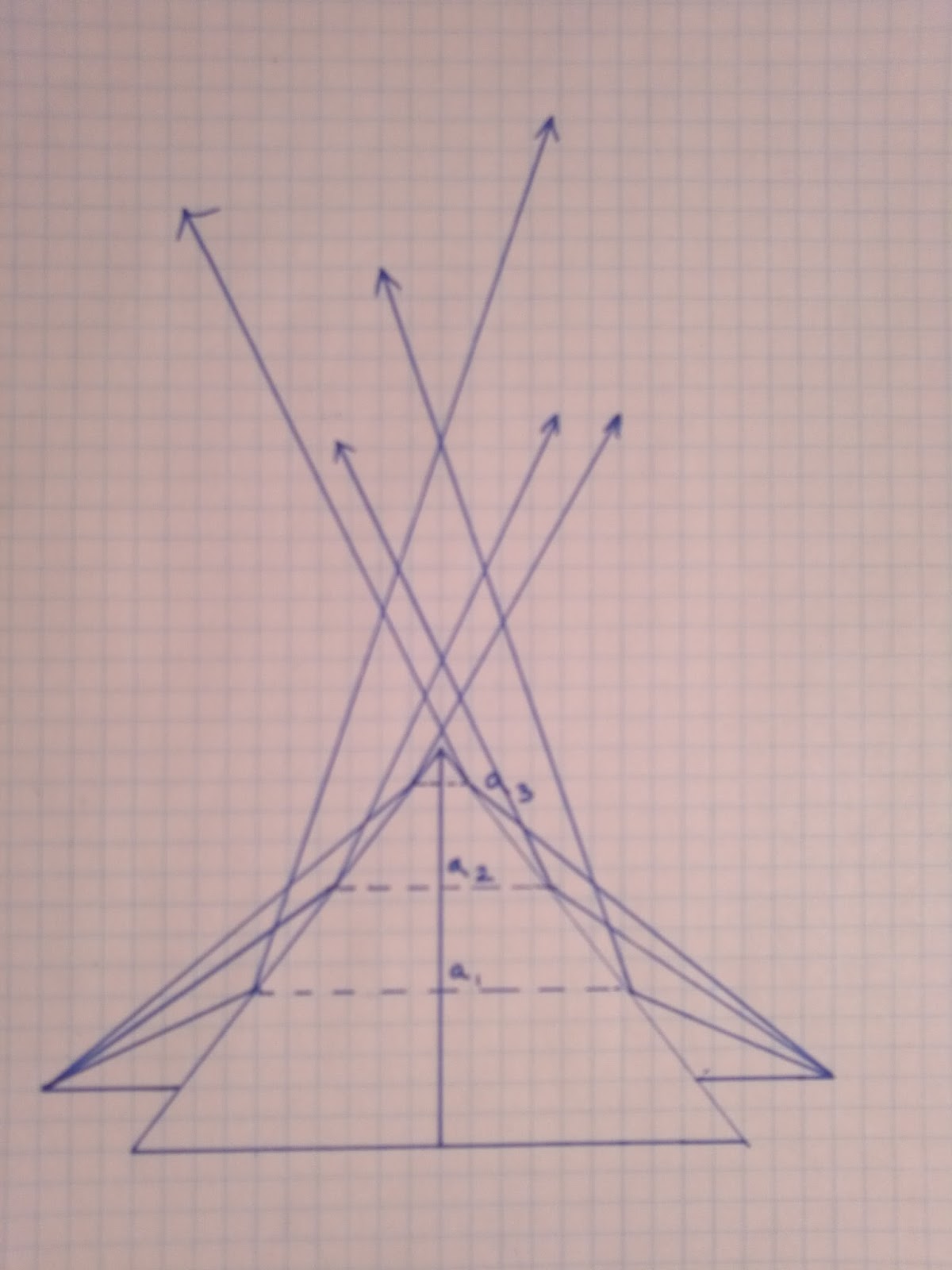
In order to observe how resolution changes with height, the viewers agree to sample a more points along the apothem at equal altitude.  As the reflection angle increases, the altitude of the point of intersection decreases.  As the reflection angle decreases, the altitude of the point of intersection increases.  The change in altitude is akin to depth perception in the eyes.

Figure 5. Change in altitude of vectors calculated at equal, but progressively greater heights.  An increase in altitude of the point of reflection results in a decrease in altitude at the point of intersection.
The following graphic shows the field of view available to a single observer at the center of the base of a face of the pyramid.  By combining the field of view available to observers at the center of all four faces, a single pyramid can be used to observe, via reflection, points that lie most anywhere within the celestial hemisphere.

figure 5 - Celestial Hemisphere

It's Three Dimensional

Figure B (above) shows the position of a star, and its reflection on four faces.  It shows iconically the reflection of the star in each of the faces.  By having each observer measure position on the face (height, distance from apothem) the angular measures can be discovered and the reflection vectors calculated.  In this case, the calculations are a bit more complex, especially finding the point of intersection of the vectors.  But the sequence is stable and consistent.


Stereoscopic Vision & Meridians

The following graphic shows how the star S from Figure B might appear to 8 observers at the faces of two pyramids.

Figure 7.  Stereoscopic view of star S in the reflections of the faces of two pyramids at time T(0).

Figure 8.  Stereoscopic view of star S in the reflections of the faces of two pyramids at time T(1).
Figure 9.  Stereoscopic view of star S in the reflections of the faces of two pyramids at time T(2).
In the series of figures (7-9), a star S is shown at three positions in time.  One of the nice features of having two pyramids aligned to true north is that each provide an arc time and angle at the meridian for each.  The earth's rotation provides a constant background to measure the arc angle and arc time against.  The arc time between the pyramids is a constant.  If something moves faster or slower than the earth's rotation, it would seem to indicate the direction of travel of the object.  Plus, if the declination or distance changed, especially as measured over time, the direction and velocity of the object would appear to be possible to determine.

While star calculations are interesting, scanning applications are pretty interesting too.  Calculating the distance to a point in space using one pyramid appears to provide high utility in that a number of vectors can be calculated, with accuracy increasing with the number of viewing positions.  The introduction of a second pyramid would seem to improve precision.

But, the ability to measure depth in the angled faces in the pyramids, combined with a relatively large distance between pyramids, means that each face can be used to construct patches of an object by collecting a range of data points from each face.  The patches constructed from the survey of the reflected points of the object in each face represent distinct views of the surface of an object, with depth, which when assembled (using reference points to align patches) would create a projection of the object in three dimensions.

It would seem that any object which could be recorded, could also be projected to reconstruct the object or location in space above a projection mechanism.  It'd be fun to see if this would work to create holographic projections.

Construction of Surfaces

Creating a scanner using the pyramids would involve utilizing a large number of observational positions to an object.  The number of observational positions and their location would vary, but the more positions records as points in space, the more surface detail to an object are recorded as a point cloud.  The ability to construct surfaces from point clouds has a set of well-defined solutions and products which facilitate surface construction.

While one pyramid is enough to get a sense of the shape of an object, using the two pyramids would seem to facilitate constructing stereoscopic images from a collection of manifolds, each created by virtue of collecting a large cross-section of points, converted to a manifold.

Conclusion

In conclusion, the math appears to support the distinct possibility that the pyramids at Giza were used to reckon stars accurately, and that the reckoning would be by arc angle, declination, and distance.  By virtue of a stable structure and a series of well-defined steps, it would be possible to calculate vector projections through a point on the face, extending into space.  The vector projections, when combined from observational positions near the original observational position, provide a stable mathematical base to calculate distance to an object.

It would seem, if the system is as stable as it appears, that with a little creativity and insight, this mechanism can provide hours of fun and entertainment to creative individuals as a surveying instrument, holographic projection system, medical scanner, surgical knife, medical 3D scanner.  Seems like whatever we would use our eyes to do could be modeled, from the highly focused to the wide angle.